
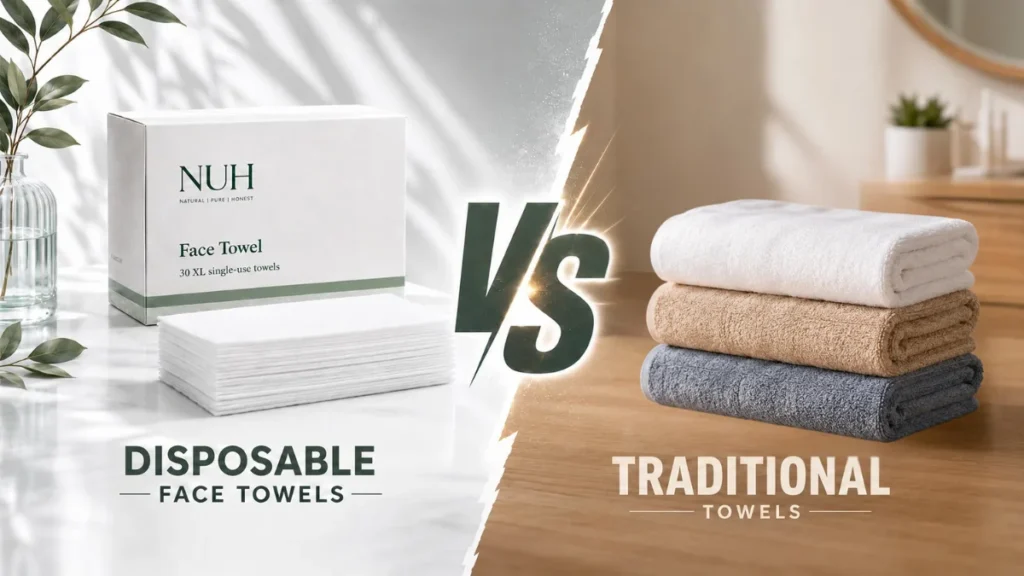
Disposable face towels vs traditional towels is an increasingly common comparison in modern skincare routines. After cleansing, many people use a towel to dry the face before applying toner, serum or moisturizer. Traditional cotton towels have served this purpose for years, while disposable face towels have become an increasingly visible alternative in skincare retail, beauty services and travel-related use.
The two products are not direct replacements in every situation. Traditional towels are reusable and practical for well-managed household routines, while disposable face towels provide a fresh, single-use option that requires no washing or drying.
This article compares their materials, convenience, texture, cost and suitable applications to help consumers, skincare brands and professional buyers make a more informed choice.
What Are Disposable Face Towels?
Disposable face towels are soft, single-use nonwoven sheets designed for facial cleansing, drying, makeup removal and everyday personal care. Unlike traditional towels, they are not made through a conventional woven or knitted textile structure.
Common material options include viscose, polyester and customized fiber blends. Viscose is generally selected for its softer hand feel and moisture absorption, while polyester can help control material cost and contribute to product strength. The final texture and performance depend on the fiber composition, GSM, production process and surface embossing.
Disposable face towels are available in different:
- Materials and fiber ratios
- Sheet sizes
- GSM and thicknesses
- Embossed textures
- Sheet counts
- Packaging structures
For example, a 25 × 30cm towel provides a relatively large surface area for facial drying and makeup removal. Product weights around 70–90gsm may be considered for a fuller, more substantial feel, although the right GSM depends on the target market, product positioning and packaging cost.
Box packaging may contain 10, 30 or 50 sheets. These options can serve different purchasing scenarios, from trial and travel packs to regular home use.
Brands interested in material, size, texture and packaging options can explore our disposable face towels range.
What Are Traditional Face Towels?
Traditional face towels are reusable textile products commonly made from cotton or other woven fibers. They can be washed and used repeatedly, making them practical for regular household routines and applications that require greater fabric volume, such as drying hair.
Their condition depends heavily on how they are managed. Washing frequency, detergent use, rinsing, drying conditions and storage all affect cleanliness, softness and long-term performance.
A properly managed traditional towel can remain hygienic and comfortable. For example, a hotel with standardized laundry procedures, sufficient towel rotation and controlled washing and drying can provide a very different experience from a poorly managed laundry process.
This highlights an important point: the product itself is only one part of the user experience. Cleaning and storage management also matter.
Disposable Face Towels vs Traditional Towels
The main difference is not simply that one product is “better.” They are designed around different usage habits.
| Feature | Disposable Face Towels | Traditional Towels |
| Use | Single-use | Reusable |
| Washing | No washing required | Requires regular washing |
| Convenience | Suitable for skincare, travel and professional use | Practical for regular household routines |
| Texture | More consistent | May change after repeated washing |
| Storage | Compact packaged format | Requires drying and storage space |
| Customization | Material, size, texture, sheet count and packaging | Mainly size, color, fabric and embroidery |
| Replacement | Replaced after each use | Used over a longer cycle |
| Cost model | Requires continuous replenishment | Reusable with a longer replacement cycle |
Use and Cleaning
Disposable face towels are used once and require no washing, drying or storage after use. Traditional towels need regular cleaning and thorough drying before reuse, which is practical in a well-managed household routine but may be less convenient during travel, business trips or gym visits.
Texture and Facial Contact
A disposable face towel usually provides a relatively consistent surface feel, depending on its material, GSM and manufacturing process. Traditional towels can also be soft, although repeated washing, detergent residue, drying methods and fabric wear may gradually change their texture and the level of friction felt during facial use.
Convenience and Portability
Disposable face towels are compact and easy to carry in travel bags, gym bags or professional skincare kits, with no damp towel to store after use. Traditional towels are generally more practical when repeated use is expected and suitable laundry facilities are readily available.
Ongoing Cost
Traditional towels can be reused over a longer period, while disposable face towels require regular replenishment. The more useful comparison is therefore the cost per use, together with convenience, washing requirements and the intended usage environment, rather than the purchase price alone.
Which Is Better for Different Uses?
The better choice depends on the user’s routine, environment and priorities. Traditional towels remain practical in well-managed reusable settings, while disposable face towels are often preferred when portability, single-use convenience and a consistent surface feel are more important.
Regular Home Use
Traditional towels are a practical choice for households with reliable washing, drying and replacement routines. They are especially suitable for users who prefer reusable products and have easy access to laundry facilities.
Skincare and Makeup Removal
Disposable face towels may be more convenient for facial drying, cleansing and makeup removal when users prefer a fresh sheet for each routine. Material softness, GSM and product strength should still be considered to ensure a comfortable experience.
Travel and Professional Settings
Disposable face towels are compact and easy to manage during travel, business trips, gym visits, beauty treatments and spa services. Traditional towels can also perform well in hotels and professional environments when they are supported by a standardized laundry and towel-management system.
What Should Brands and Professional Buyers Consider?
Professional buyers should evaluate more than the initial unit price. Product consistency, packaging execution, sampling, lead time and trade terms all affect whether a private label project can be delivered reliably.
Important factors include:
- Raw material quality and consistency
- Size and GSM tolerance
- Embossing stability
- Packaging structure
- Printing color and artwork accuracy
- Private label requirements
- MOQ and sampling process
- Lead time
- Quality inspection
- Supply and price stability
Raw material consistency is particularly important. Two towels with a similar appearance may provide different softness, absorption and strength if the underlying fiber quality or production control changes.
New packaging should normally be sampled before mass production. A physical sample allows the buyer to confirm the printed information, color accuracy, box structure and how the towel material fits and appears inside the package.
Changing the material, sheet size and packaging at the same time can increase development complexity. A customized sheet size may require production adjustments, a higher MOQ or a longer development schedule.
In one private label project, competitive pricing alone was not enough for the buyer to make a decision. Product samples, packaging artwork support and a clear quotation helped the customer evaluate the complete product and packaging solution before moving forward.
Professional buyers should therefore compare the supplier’s complete project capability rather than selecting a partner based only on the lowest quotation.
Brands developing new products can review our OEM disposable face towel solutions for available material and packaging options.
Conclusion
When comparing disposable face towels vs traditional towels, each option serves a valid purpose. Traditional towels remain practical for repeated use when proper washing, drying and storage are available, while disposable face towels are better suited to situations where portability, single-use convenience and a relatively consistent surface feel are priorities.
For brands and professional buyers, the most suitable product should be selected according to the target customer, sales channel and intended use. Material, GSM, size, embossing, sheet count and packaging need to work together as a complete product solution.
The highest GSM or lowest quotation is not always the best choice. A reliable product depends on balanced specifications, consistent raw materials, accurate packaging execution and stable delivery.
Explore NUH Textile’s custom disposable face towel options for different materials, sizes, textures and private label packaging.
Frequently Asked Questions
Can disposable face towels be used every day?
Disposable face towels can be used for daily facial cleansing and drying when the material, softness and strength are suitable for the intended application. Users should avoid excessive rubbing and choose a product that feels comfortable on the skin.
Can disposable face towels be used wet and dry?
Some disposable face towels can be used in both wet and dry applications. This depends on the fiber composition, material strength and overall product design.
What size disposable face towel is suitable for facial care?
There is no single required size. A 25 × 30cm towel provides relatively broad coverage and can be folded during cleansing, facial drying or makeup removal. Smaller sizes may be more suitable for trial packs or travel packaging.
Can disposable face towel packaging be customized?
Yes. Packaging can be customized in terms of box structure, sheet count, artwork, logo, brand colors and label information. MOQ and lead time depend on the level of customization and total order quantity.