
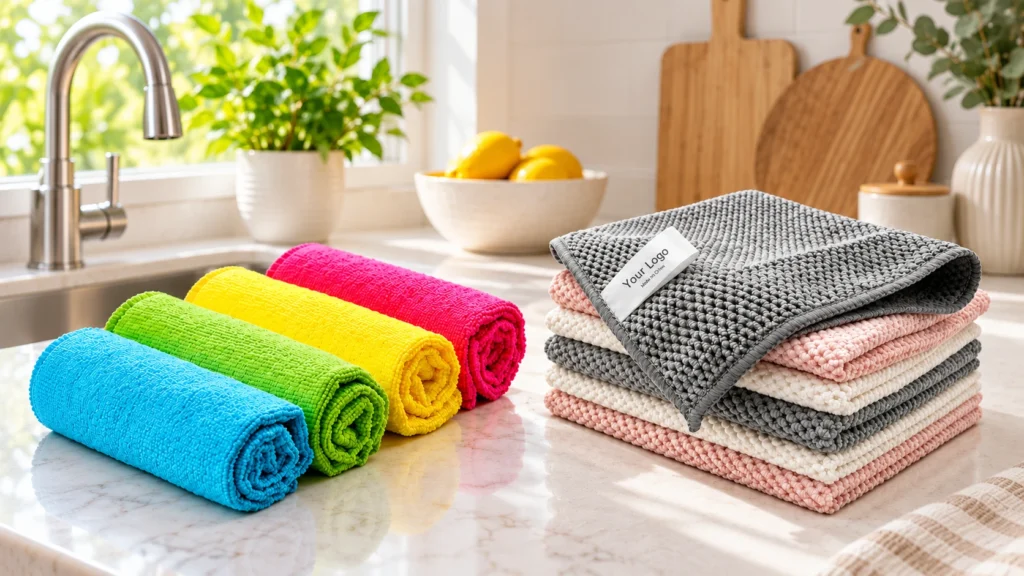
Buying microfiber cleaning cloths in bulk involves more than comparing fabric composition, GSM and unit prices. Two products with similar specifications may use different knitted structures, finished sizes or packaging formats—factors that can change how a cloth is used and how an order is priced.
For wholesalers, importers and private label brands, the starting point should be the intended cleaning task, sales channel and product requirements.
This guide explains how to evaluate microfiber cloth construction, compare GSM specifications and identify sourcing details that are easy to overlook before placing a bulk order.
Start With the Cleaning Task and Sales Format
The first step in sourcing microfiber cleaning cloths is to define where the product will be used and how it will reach the end customer.
For example, a retailer developing a household cleaning range may prioritize consistent sizing, coordinated colors and shelf-ready multipack packaging. A distributor supplying commercial cleaning customers may place greater emphasis on cloth specifications, repeat-order consistency and cost per piece.
The cleaning task also matters. General household wiping, kitchen cleaning and vehicle care do not necessarily require the same fabric surface. Buyers should consider the materials being cleaned, whether the cloth will be used wet or dry, and whether the surface is sensitive to abrasion.
Packaging format is a separate purchasing decision. NUH Textile’s CT002 range includes a 36-piece retail pack, while other microfiber cleaning cloths can be supplied individually or developed into customized multipacks.
When comparing quotations, buyers should confirm whether the price and MOQ refer to individual cloths or complete packs. A quotation for 1,000 packs cannot be directly compared with one for 5,000 pieces without checking the number of cloths, dimensions and packaging included.
Defining the cleaning application and sales format first makes subsequent fabric selection and supplier comparisons more meaningful.
How Fabric Construction Changes Product Selection
Fiber composition describes what a cloth is made from, but it does not fully explain the structure of its cleaning surfaces.
Knitting patterns, pile length and reverse-side construction can differ even between products sold under the same general description of microfiber cleaning cloths.
For example, NUH Textile’s CT002 uses a warp-knitted loop-pile microfiber construction, with 85% polyester and 15% polyamide as the standard composition. Both sides have a loop-pile surface, although the pile lengths differ slightly.
This distinction may not be obvious from a standard product photograph. Buyers should examine actual samples to understand the fabric’s surface texture and handling characteristics.
CT003 offers another construction approach. The featured double-sided corn-grain cleaning cloth uses a knitted surface with a more pronounced texture and a standard fabric weight of 330 GSM.
Other available constructions include a corn-grain microfiber surface combined with a PP scrubbing reverse. This provides two surfaces for different cleaning tasks: a softer microfiber side for wiping and a PP side for scrubbing more stubborn dirt on suitable surfaces.
However, a PP scrubbing surface is not recommended for car paintwork or delicate, scratch-sensitive finishes. Buyers should confirm the intended cleaning surfaces before choosing this construction.
A useful sample evaluation should therefore cover both sides of the cloth, the knitted structure, edge finishing and the surfaces on which the product is intended to be used.
Rather than assuming that one fabric construction is universally better, buyers should select the structure that fits the cleaning application and verify it through physical samples.
GSM, Fabric Composition and Production Tolerances
GSM stands for grams per square meter. It measures fabric weight per unit area, but it does not independently determine softness, cleaning performance or finished cloth weight.
For reference, NUH Textile’s CT002 uses a standard 300 GSM microfiber fabric, while CT003 uses a standard 330 GSM corn-grain textured fabric. Their compositions and knitted structures also differ, so the GSM values should not be treated as a direct performance ranking.
A higher GSM does not necessarily mean a heavier individual cloth.
Consider two fabric panels:
- A 40.64 × 40.64 cm cloth made with 300 GSM fabric contains approximately 49.5 g of fabric.
- A 30 × 40 cm cloth made with 330 GSM fabric contains approximately 39.6 g of fabric.
These figures are calculated from fabric area and nominal GSM. They are not measured finished-product weights and do not account for differences in edge construction, labels or other components.
The example illustrates why buyers should compare GSM and dimensions together, rather than assuming that a higher GSM always means more material per finished piece.
Production tolerances are another practical consideration.
According to manufacturing feedback collected for NUH Textile’s cleaning cloth projects, GSM can vary by approximately ±3% during production. This is a production reference, not a universal tolerance standard.
For bulk orders, buyers should agree on the acceptable GSM range before production and confirm how it will be checked. The approved sample, specified dimensions and agreed material requirements should form the basis for subsequent quality inspections.
The most useful comparison is not simply 300 GSM versus 330 GSM. It is a comparison of fabric construction, composition, dimensions, acceptable tolerances and the intended use of the finished cloth.
Why MOQ and Packaging Requirements Affect Your Quote
When sourcing microfiber cleaning cloths, a supplier’s minimum order quantity may refer to individual pieces, retail packs, a specific fabric color or customized packaging materials.
These quantities need to be evaluated separately.
For example, NUH Textile’s CT002 is available in a standard 36-piece retail pack with a starting MOQ of 1,000 packs. This represents 36,000 individual cloths, but the final production arrangement also depends on the selected colors, pack configuration and packaging requirements.
Custom printed packaging may have a different production minimum. In one packaging arrangement, printed retail bags require a minimum production run of 5,000 bags, even when the initial cloth order is only 1,000 packs.
The remaining bags may be reserved for future orders if both parties agree on storage, ownership and packaging specifications. However, this arrangement should not be assumed without confirmation.
Printing setup costs also deserve attention. The number of printed colors can affect plate charges, while changes to packaging artwork may require additional setup.
For assorted-color packs, buyers should confirm whether the chosen color quantities meet the applicable fabric production minimums.
A useful quotation should therefore distinguish between:
- Cloth quantity and price per piece
- Pack quantity and the number of cloths per pack
- Minimum production quantity for each color
- Printed packaging MOQ and setup charges
- Logo, label and other customization costs
Comparing these items separately helps buyers understand the actual cost of the first order and plan more accurately for repeat purchases.
Sampling and Quality Checks Before Bulk Production
An approved sample should establish more than the appearance of a cleaning cloth. It should confirm the fabric construction, GSM, dimensions, edge finishing, color and packaging details that the supplier is expected to reproduce.
For custom microfiber cleaning cloth projects, NUH Textile’s manufacturing partners carry out checks at different stages of production.
Initial checks cover fabric GSM, color and surface construction. During production, attention is given to dimensions, edge finishing and visible workmanship. Finished products are inspected for defects, stains and other appearance issues, while packaging checks include labeling, printing and pack quantities.
These routine inspections are useful, but buyers should distinguish factory checks from laboratory testing.
For example, a visual inspection cannot independently establish long-term wash durability, abrasion resistance or a specific absorbency rate. Where such performance claims are important, buyers should request applicable test evidence and confirm which material or product configuration it covers.
Before approving bulk production, buyers should also agree on measurement tolerances, reference samples and acceptance requirements.
Clear written specifications reduce the risk of disagreements caused by differences between a sample, production expectations and finished goods.
Microfiber Cleaning Cloth RFQ Checklist
A detailed request for quotation helps suppliers recommend suitable specifications and provide more comparable pricing.
Before requesting a bulk quotation, prepare the following information:
- Application: Household, kitchen, automotive, commercial cleaning or another intended use.
- Fabric: Preferred microfiber composition, surface texture and construction.
- GSM and size: Target fabric weight, dimensions and acceptable tolerances.
- Colors: Required colors and estimated quantity per color.
- Product format: Individual cloths, multipacks or retail-ready packaging.
- Branding: Logo, woven label, care label or other private label requirements.
- Packaging: Pack quantity, packaging material and printed artwork requirements.
- Order quantity: Total number of pieces or packs, clearly identifying the unit.
- Destination: Country or market of import, along with any specific compliance or documentation requirements.
For projects with several possible fabric constructions, requesting representative samples before finalizing the specification can help avoid unnecessary changes during production.
Buyers can explore NUH Textile’s custom microfiber cleaning cloth solutions to compare available product formats, fabric options and private label possibilities.
A well-defined RFQ is not simply a way to obtain a price. It establishes a clearer starting point for product development, quotation comparison and bulk order planning.